
The Library That Builds Itself
Why knowledge management failed for thirty years, what just changed, and what it means for the firms that figure it out first.

In 1945, Vannevar Bush published “As We May Think” in The Atlantic and created a blueprint for human knowledge augmented and extended by a machine. In the wake of World War II, Bush had seen the potential of scientists putting aside professional competition to work in concert for a greater cause. His article was partly a call to carry that spirit of cooperation into the coming age, and a hypothetical rumination of how technology could preserve, extend, and facilitate the exchange of human knowledge.
Bush describes a hypothetical machine he called the Memex that would store all of an individual’s books, records, and communications, and let the user follow associative trails between documents the way a mind moves between related thoughts. Bush imagined a private, curated, deeply personal knowledge store where the connections between ideas were as valuable as the ideas themselves.
The Memex was never built, but his vision would prove influential in the following decades as the technologies that would make it possible became widely spread.
It was not a lack of interest that kept the Memex from being built all those years, for many had tried and failed. The limiting factor was the human effort to build and maintain the system far surpassed its potential benefits. This delta only compounding with complexity.
That obstacle blocking Bush’s idea from coming to fruition was truly removed in April 2026, and most of the firms that would most directly benefit, have not noticed.
The billion dollar knowledge graveyard
Every generation of enterprise software has taken a swing at a version of the Memex. Lotus Notes was the first commercial groupware platform to make a serious run at it in the late 1980s and 1990s. Microsoft followed with SharePoint. IBM, Oracle, and a long parade of vendors built document management systems, intranets, expert directories, and tagged repositories.
McKinsey has famously invested millions into their knowledge development, learning, and capability building, and built a dedicated function staffed by research analysts whose full-time job was to capture, sanitize, tag, and curate the firm’s intellectual capital. By 2023, the firm was publicly acknowledging that across 40+ internal knowledge sources and 100,000+ curated documents, its 45,000 consultants still could not effectively access what the institution already knew.
The pattern is consistent across thirty years and every generation of technology. The vision is correct, the investment has been substantial, and the execution has failed at the same point in every implementation.
Why it failed
Since the early-2000s, the bottleneck to build the Memex hasn’t been technology. It has been the cost in human capital.
Every knowledge management system built since Lotus Notes has assumed that knowledge workers would do the maintenance work themselves: tagging documents, filing them correctly, writing summaries, linking related concepts, updating the wiki when context changes, sanitizing client materials before upload. These tasks are real work, and they accrue to the person doing them, while the value accrues to whoever queries the system later. The economics are upside down.
The result is the same in every implementation: files get dumped without tags, wikis go stale, and summaries do not get written. The repository becomes an attic. People stop trusting it, then stop contributing to it, then stop using it. Senior leaders with the most valuable knowledge are also the most expensive to redirect into bookkeeping, so they do the least of it.
The professional services answer was to throw bodies at the problem. Firms hired librarians, KM directors, and content managers. It worked at the margin, mostly because the firms with the budget and culture to staff the function also had the discipline to enforce contribution. Outside that elite tier, KM has been a managed failure for thirty years. Most firms have a SharePoint that nobody trusts, a shared drive that nobody can navigate, and an institutional memory that walks out the door whenever a senior partner retires.
The personal Second Brain
In 2017, Tiago Forte launched an online course called Building a Second Brain. He had spent years developing a personal system for capturing and organizing information, originally to manage a chronic medical condition that required him to track and synthesize his own records across specialists. The system, formalized in his 2022 book of the same title, gave individual knowledge workers a methodology for building Bush’s Memex on their own desktop. Forte’s framework, called PARA (Projects, Areas, Resources, Archives), turned personal knowledge management into a practice that thousands of people could actually run.
What Forte solved was the personal version of the maintenance problem. One person, working alone, can stay disciplined enough to capture, organize, distill, and express their own knowledge. The system is portable, simple, and tool-agnostic.
Forte’s framework was harder to scale into firms because the maintenance problem returned at institutional scale. A solo practitioner can keep their own wiki current. A firm of three hundred professionals across twenty practice areas, four hundred active engagements, and twenty years of accumulated client work cannot.
Karpathy’s insight
On April 4, 2026, Andrej Karpathy published a markdown file on GitHub describing a pattern he called the LLM Wiki. The file was short, pragmatic, and meant to be copy-pasted into any AI agent. It went viral in the developer community within days.
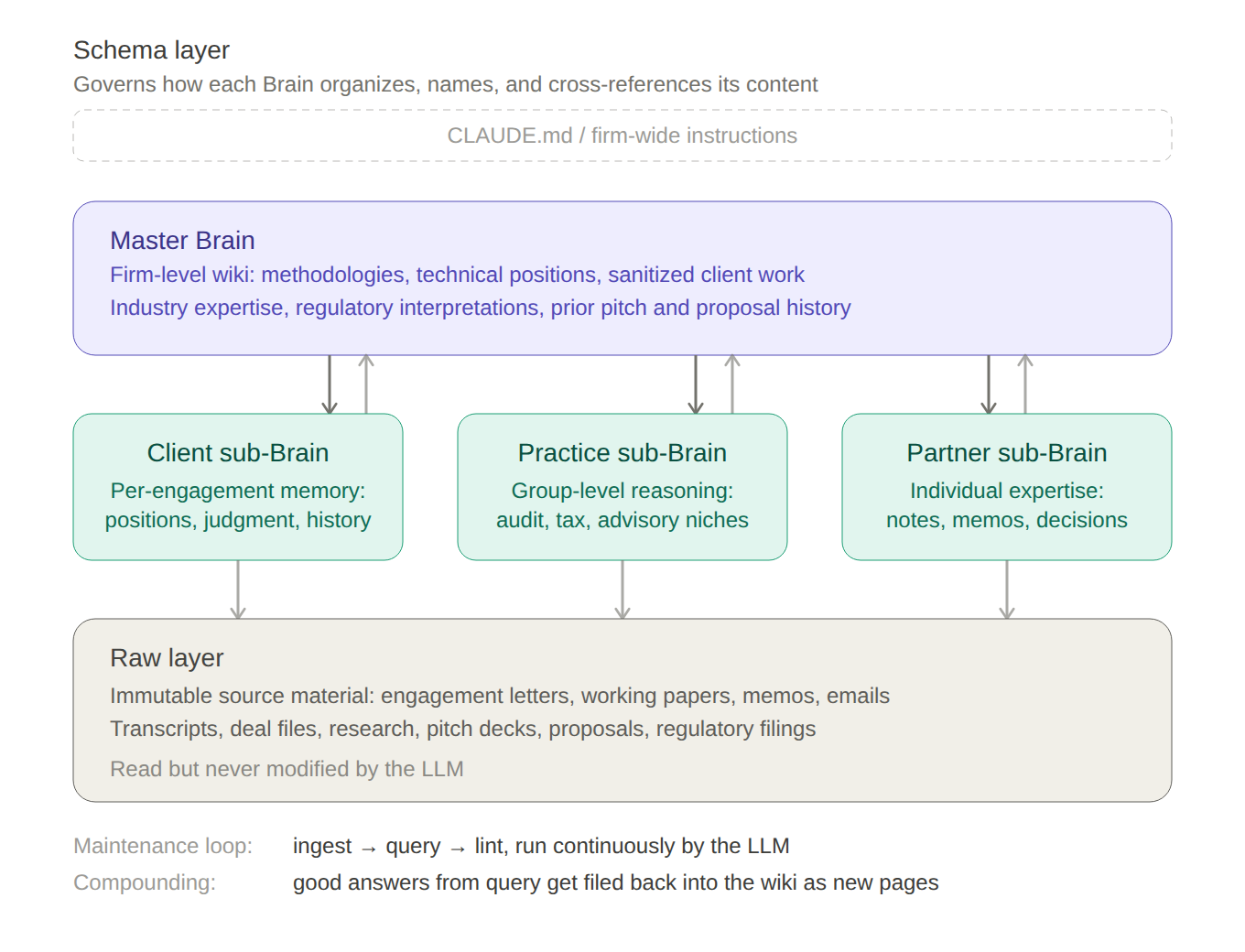
The architecture has three layers. Raw is a folder of immutable source material: documents, transcripts, articles, notes, anything you want to remember. Wiki is what the LLM builds on top of raw: summary pages, concept pages, entity pages, comparison tables, all interlinked through wiki-style references back to the original sources. Schema is a single instruction file that tells the LLM what the knowledge base is for and how to organize it.
The compounding loop runs in three operations. Ingest: when a new source arrives, the LLM reads it and updates the wiki, often touching ten to fifteen related pages. Query: questions are answered against the wiki rather than against raw sources, with citations back to the originals. Lint: periodic audits surface contradictions, orphan pages, and gaps that need filling. Good answers from the query step get filed back into the wiki as new pages, which means explorations compound rather than evaporating into chat history.
Karpathy’s own wiki reportedly reached around 100 articles and 400,000 words while the LLM could still navigate it efficiently through summaries and indexes. At that scale, the system was faster and more accurate than a traditional retrieval setup for his research use case.
Karpathy’s pattern resolves the eighty-year Memex problem by handing the maintenance layer to the model. The LLM does not get bored, does not forget to update a cross-reference, and does not deprioritize bookkeeping when a deadline hits. The thing that has prevented institutional knowledge management from working since Lotus Notes is no longer a constraint.
The institutional Second Brain
What this enables at firm scale is a layered architecture that is now operationally possible for the first time.
A Master Brain at the firm level holds the institution’s accumulated reasoning: methodologies, frameworks, sanitized client work, technical positions, regulatory interpretations, industry-specific risk assessments, prior pitch and proposal history. Sub-Brains sit beneath it for each client, each practice area, each engagement. The sub-Brains feed the Master Brain as new work generates new knowledge. The Master Brain informs the sub-Brains by surfacing relevant precedent, methodology, and prior reasoning when a new engagement begins.
The raw layer underneath both is the firm’s actual document corpus: engagement letters, working papers, memos, emails, transcripts, deal files, research, and the thousand other artifacts of professional work. The schema layer above tells the model what each Brain is for, how to organize it, and what naming conventions to enforce.
The maintenance work that previously failed at every firm now happens continuously and automatically. A new client memo gets ingested. Ten cross-references update. A flagged contradiction gets surfaced. A new engagement begins, and the sub-Brain spins up populated with everything the firm already knows about the client, the industry, the technical issues at play.
The audit firm moat
A senior manager picks up a continuing audit client in October. The engagement has been running for eight years. Three different partners have rotated through. The current managing partner is two years from retirement. The working papers are in CCH or Caseware and the technical positions are documented. The judgment calls behind those positions, the conversations about gray areas, the partner’s reasoning for accepting or rejecting management’s classification, the auditor independence considerations that came up when the client acquired a related entity, the running history of how the firm has handled this client’s idiosyncrasies, all of it lives in three or four senior heads and a scattered email trail.
When the partner retires in 2027, that institutional reasoning leaves with them. The new partner inherits a clean working paper file and a client relationship they have to rebuild from the ground up. Even though the firm has done the engagement for eight years, and knows the business better than anyone else outside the organization, they need to effectively start over.
The institutional Second Brain changes the math. The sub-Brain for that client has captured eight years of memos, conversations, technical positions, and judgment calls. The Master Brain holds the firm’s accumulated reasoning across hundreds of similar engagements. The new partner inherits not just the file but the institutional thinking that produced it. The audit risk assessment for the next year reflects everything the firm has ever learned, not just what is in this manager’s head.
Multiply that by every client, every engagement, every retiring partner.
The compounding moat
Two firms with identical talent, identical client rosters, and identical methodologies will diverge sharply over five years if one builds an institutional Second Brain and the other does not. Year one is marginal. Year three is meaningful. Year five is structural.
The firm with the denser, better-maintained institutional memory will price differently because its risk models reflect more accumulated reasoning. It will pitch differently because new business conversations start with institutional precedent. It will develop associates faster because junior staff have access to the firm’s actual thinking, not just its templates. It will retain leaders better because the firm becomes more valuable than any individual contributor.
This is something different than a linear, copyable productivity gain available to any firm with the budget for the same tools. A knowledge moat that compounds across every engagement, every memo, every retiring partner, is not something a competitor can buy. And unlike most professional services moats, it does not depend on a star partner who can be poached.
The firms that build their Second Brains in 2026 will be operating with five years of compounded institutional knowledge by 2031. The firms that wait will be hiring against them, pitching against them, and watching their senior partners walk out the door with knowledge their competitors have already captured.
Bush published “As We May Think” eighty-one years ago, with the right vision and the wrong tools for the maintenance layer that vision required. The maintenance layer is no longer the wall, and the firms that notice first will inherit the future of professional services.